

Developing Noguchi to Asawa: Designing Postwar America





PDF: Kang, Developing Noguchi to Asawa
As the historic location of the signing of the Declaration of Independence, Philadelphia is known as the “birthplace of America.” The 250th anniversary was thus a major focus of planning and programming for several years in cultural institutions and organizations across the city. Convenings of local arts leaders at the Barnes Foundation began in 2022 to discuss various approaches, perspectives, and potential collaborations. The Barnes decided to commemorate the semiquincentennial by devoting its 2026 exhibition program to American artists and American stories. Although Dr. Albert Barnes was a stalwart supporter of American artists as a collector and educator, his foundation is more known for its extraordinary modern European art collection. Featuring American rather than French art for the year was thus a statement in itself for the institution.1
The 250th anniversary became the ideal occasion for me to revisit and rethink a project that had been shelved after going through various fits and starts for several years. In 2019, with the encouragement of our director and one of the Barnes’s longtime supporters, I began exploring the possibility of an installation of Ruth Asawa’s (1926–2013) sculpture in our Annenberg Court, a vast public space that we wanted to activate more regularly with works of art. We had installed our first commission in that space, Pat Steir’s Silent Secret Waterfalls: The Barnes Series, in January 2019 and were hoping to develop the next Annenberg Court project.
Asawa’s work and ethos aligned with many of Dr. Barnes’s strongly held beliefs: the connection between art and everyday life, the relationship between artistic forms across cultures, a disregard for the hierarchy between fine art and craft, and above all, a passion for art’s central role in progressive education. As I developed my ideas around Asawa and how her work related to the context of the Barnes, it became clear that the project should expand to become a full exhibition in our Roberts Gallery. I was interested in adding more sociohistorical texture to the modernist narrative and white-cube setting in which her work is usually presented. What did it mean, for example, to be a second-generation Asian American artist working in the postwar segregated United States? How could we understand her forays into commercial design and the early reception of her work in interior design settings? Are the two related in any way? In 2020, we thus began a dialogue with the artist’s estate to create a meaningful project that would deepen and complicate our understanding of the artist. The family was particularly interested in bringing more attention to her early work in other media alongside her iconic sculpture.
I devised an exhibition proposal that was centered on Asawa’s experiences at Black Mountain College (BMC) in North Carolina, which she attended from 1946 to 1949. It examined core themes that emerged during her time at BMC—nature and biology, dance and geometry, creative reuse of everyday materials, color theory and race, art in education—and explored how they bore fruit later in her career. Black Mountain College was in fact linked to the Barnes through the philosopher John Dewey. Dr. Barnes visited BMC with Dewey in 1935 at the invitation of the founder and rector of the college, John A. Rice. The teaching methods of both institutions were based on Dewey’s philosophy of pragmatism and progressive education, which valued experiential learning and placed art at the center of a democratic enterprise. One of the foundational texts for BMC’s pedagogical approach was Dewey’s Art as Experience (1934), which not only quotes Dr. Barnes’s own writings but is also dedicated to him. It would therefore have been fitting for the Barnes Foundation to focus on the Black Mountain experience of Asawa.
Unfortunately, between the uncertainties of working through the COVID-19 pandemic and competing institutional calendars, this project was shelved in 2021. Nevertheless, Barnes leadership remained interested in the concept, and planning for the semiquincentennial created an opportunity to resurrect it in some form. Following the spirit and legacy of its founder, the Barnes aimed to feature not just American art but more specifically the counternarratives of marginalized American voices in its commemoration of the 250th anniversary. Thus, in 2023, I began thinking about the Asawa project again within this framework, as part of a constellation of projects that interrogated American history and identity from the viewpoint of Native American, African American, and Asian American artists.2 Of course, coming out of the COVID era, the landscape of American race and identity had greatly shifted. With regard to Asian American communities, the Atlanta spa shootings in 2021 became a clarion call for the Stop Asian Hate movement, bringing attention to the sharp increase in anti-Asian violence during the pandemic.3 Race and Asian American identity had never before received such scrutiny in my adult life.
In this context, the exhibition project became both broader and more focused. Instead of having one section in the exhibition consider the notion of race, it became a central question informing all the sections of the show. And rather than a monographic project, the exhibition expanded into a group show featuring the work of six Japanese American artists of the mid-twentieth century. From the practical side of exhibition organizing, I could also no longer devise a monographic project on Asawa for 2026, given the major retrospective that the San Francisco Museum of Modern Art and the Museum of Modern Art, New York, were now organizing on the artist. This situation, however, gave me an opportunity to take an intellectual risk.
Thinking about the counternarratives of Asian American history, I began reflecting on Japanese American incarceration during World War II as a pivotal moment for postwar Asian racial formation and the development of an Asian American movement. I decided to build a project that traces the vestiges of this traumatic event in American art through the work of major Japanese American artists affected by it. The chronological boundaries of the project thus extend from just before World War II to the founding of the Asian American Political Alliance in 1968. I wanted to focus on the period before such a self-conscious, pan-Asian collective was born, in order to understand how it arose. I wanted to complicate the dominant formalist understanding of works by artists like Asawa with the added context of racialization.
As I began to build the project, two exhibitions that I had seen and admired helped me conceptualize its structure: In a Cloud, in a Wall, in a Chair: Six Modernists in Mexico at Midcentury at the Art Institute of Chicago (September 6, 2019–January 12, 2020) and The Shape of Time: Korean Art after 1989 at the Philadelphia Museum of Art (October 21, 2023–February 11, 2024). The Chicago show demonstrated that six was an effective number of artists to include—enough to argue for a collective narrative of a historical moment but not so many that the visitor could not grasp the individual stories of each. I also chose to focus on design and craft—and their dialogue with sculpture. I wanted the visitor to see that through objects made for the home, Asian American history is not separate from mainstream America but rather part of people’s daily lives.
I thus selected six artists who had important practices in those fields and helped define the aesthetics of the postwar American home: sculptor and designer Isamu Noguchi (1904–1988), architect and furniture designer George Nakashima (1905–1990), sculptor Leo Amino (1911–1989), graphic designer S. Neil Fujita (1921–2010), fiber artist and weaver Kay Sekimachi (born 1926), and sculptor Ruth Asawa. They represented two generations of artists straddling incarceration during World War II—the elder Noguchi, Nakashima, and Amino, who all established their practices before the war changed the direction of their careers; and the younger Fujita, Sekimachi, and Asawa, whose early artistic experiences in the incarceration camps influenced their future careers as artists. I was interested in including artists from both coasts, male and female, with different relationships to incarceration to demonstrate that this was not just a West Coast story but a national one. Noguchi self-interned in Poston, Arizona, for example, while Amino was not forced to move to the camps but was nevertheless affected by the implications of incarceration.
In conceiving of the sections of the exhibition, I knew I did not want to proceed artist by artist but rather to juxtapose the work of all six. I took inspiration from The Shape of Time, which began with an introductory section addressing the aftermath of the Korean War, the creation of the demilitarized zone between North and South Korea, and the uprising against a military dictatorship. From this rather sobering and political beginning, the following thematic sections explored concepts like tension, displacement, conformity, and feminist resurgence. These themes served as overarching ideas that allowed disparate works conveying varied perspectives on contemporary Korean culture to be in dialogue with each other.
For the Barnes project, I decided to begin with a rather heavy historical section, “Prelude and Incarceration,” which examines the artists’ works and experiences prior to and during World War II. The following sections, “Minor Arts,” “Neither/Nor,” “Transparency,” and “Labor and Industry,” are all conceptual categories that serve double duty—on the one hand, they reference the classification of media (namely, sculpture versus craft or design) as well as materials and techniques; on the other hand, they also pertain to Asian racial formation and the experiences of Japanese Americans in the postwar era (figs. 1–2). The final section, “Designing Modern America,” brings together the work of all six artists in an evocation of the postwar living room that hopefully reveals how the history of Asian America is foundational to modern American art and design.
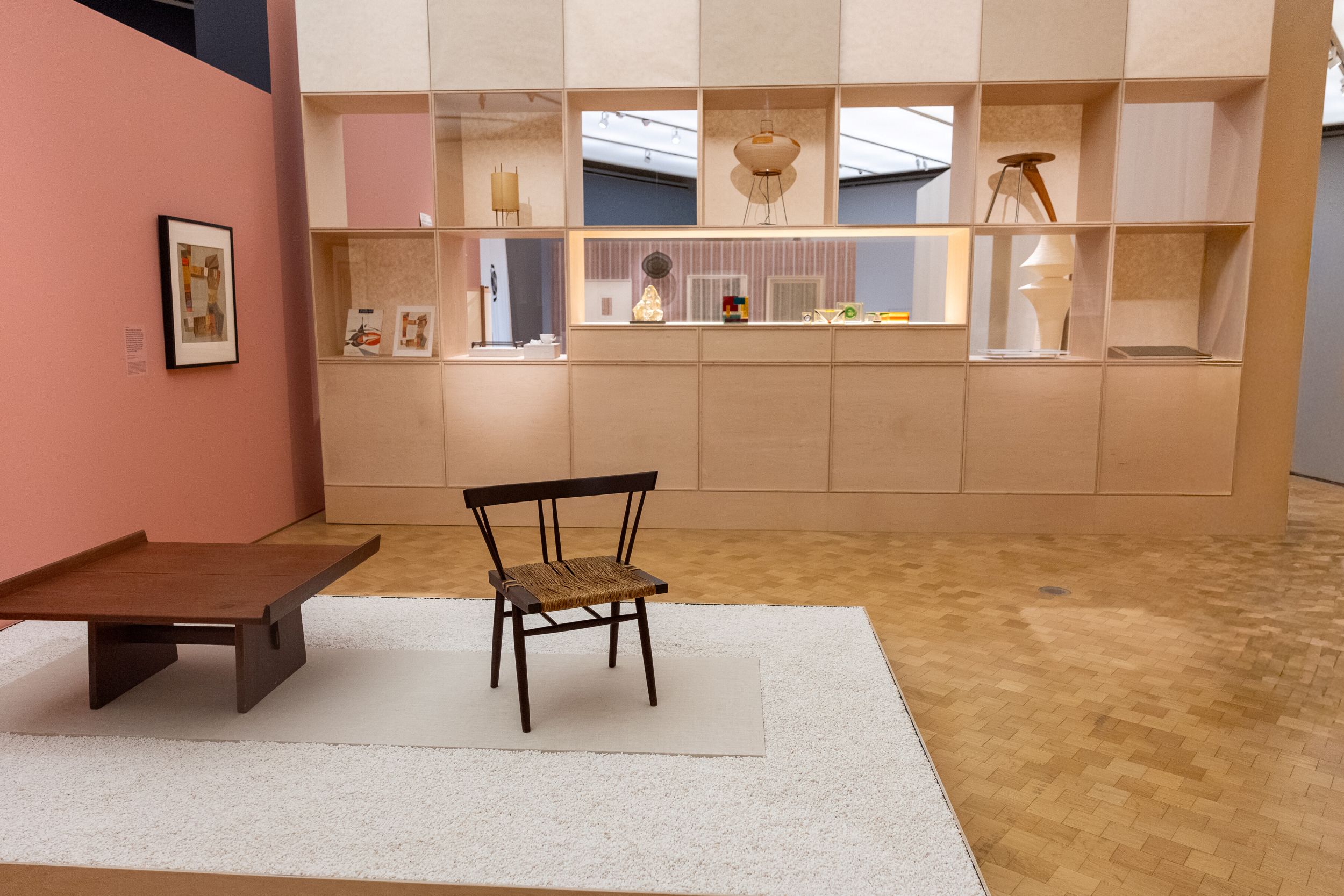
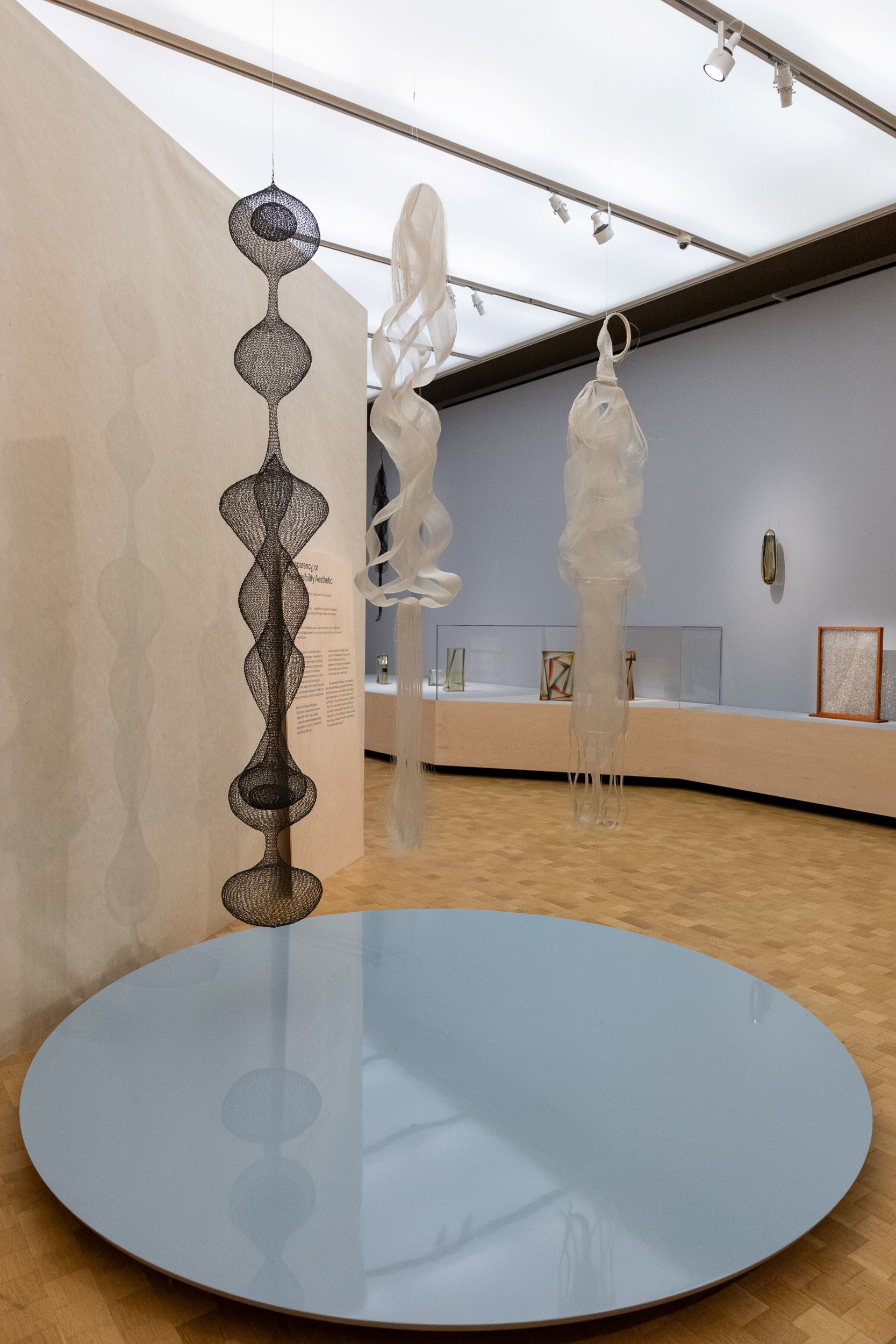
The working title I used for the project for a few years was Designing (Asian) America: Noguchi to Asawa. It gestured toward the intellectual framework of the exhibition, setting these artists’ work against the backdrop of a burgeoning concept of Asian America. I knew this would not be the final exhibition title, however. It was problematic not only from a marketing perspective, with its use of parentheses, but also it implied a misleading exclusivity and deliberate agency on the part of the artists. In other words, the diverse collective of peoples that comprise Asian America could not be represented by Japanese American artists who had no intention to design for it.
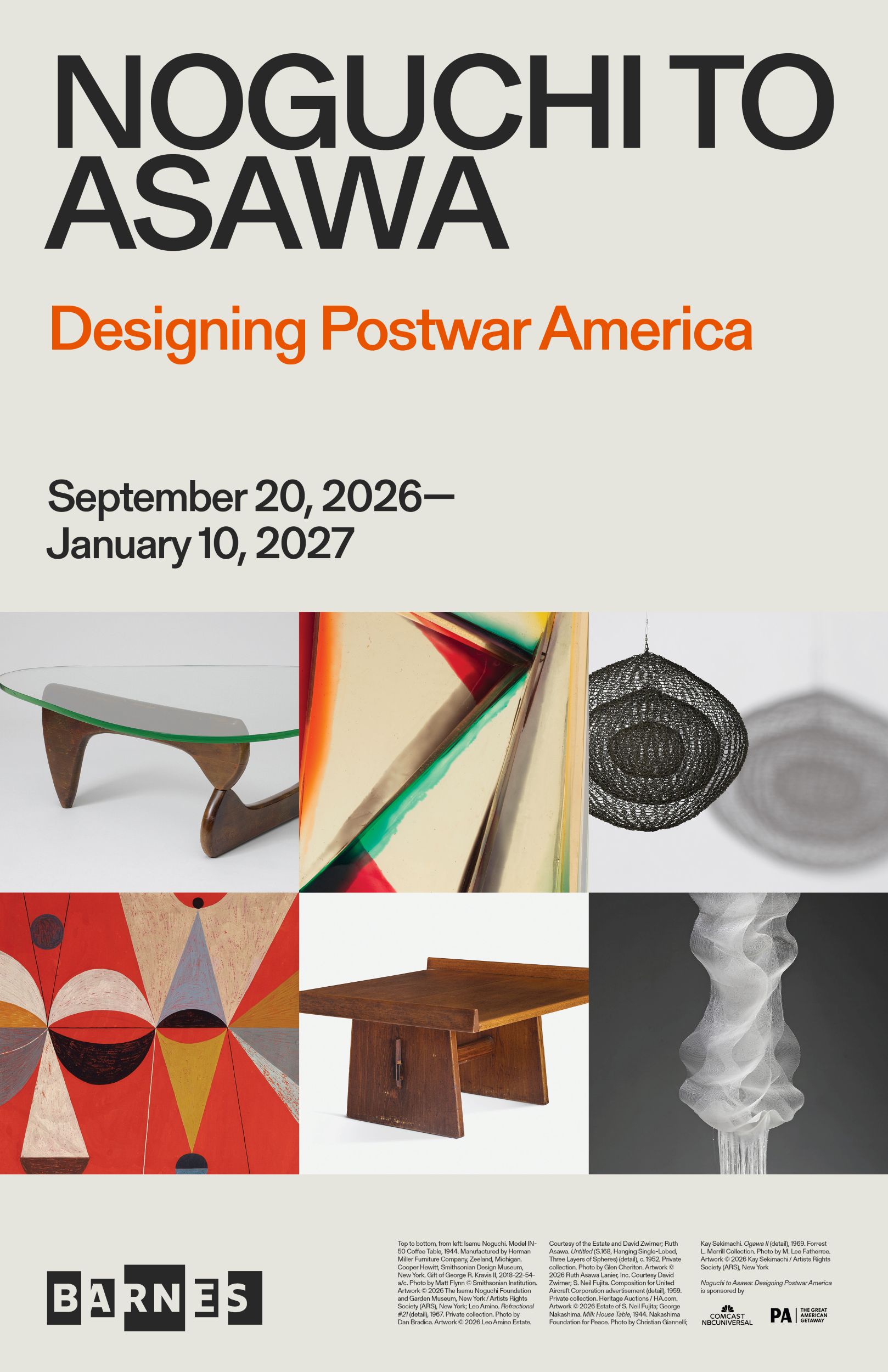
In October 2025, staff from marketing, advancement, communications, publications, retail, and curatorial met to choose a final exhibition title. Emphasizing the artists and the historical focus of the show, we agreed on a straightforward option, Noguchi to Asawa: Designing Postwar America (fig. 3). This was not a contentious decision, especially as I had suggested this title as my own frontrunner, since I was aware of the issues with my working title. Moreover, in March 2025, the Executive Order “Restoring Sanity to American History” censured the Smithsonian American Art Museum’s exhibition The Shape of Power: Stories of Race and American Sculpture. Given this climate, I was cognizant that using “Asian America” in the title might attract unwanted attention that would distort the argument of the exhibition. It was later reported that Smithsonian staff were asked to delete the word “unjustly” from a label describing Japanese American incarceration during World War II.4 Luckily the Barnes, as a private institution, would not be subject to such specific censorship, and such news only made it more important to maintain the integrity of the project.
Despite the executive order, the Barnes Foundation remained committed to its semiquincentennial programming. Indeed, the 250th anniversary gave me the opportunity to create a project that was not as literally tied to the history of the Barnes as a Black Mountain exhibition would have been but rather brought forward the broader legacy of the institution.5 It offered a pertinent context for an Asian American exhibition at the Barnes, one that was unapologetically focused on the formation of a racial identity and examining the legacy of a historical injustice. We could not have planned the exhibition’s unfortunate relevance today, with the return of US government-sanctioned imprisonment and mass deportation of immigrants. Noguchi to Asawa’s framing within the semiquincentennial speaks even more strongly to the importance of helping the public understand the history of this country and consider how the contested nature of national identity and citizenship continues to affect American lives.
Cite this article: Cindy Kang, “Developing Noguchi to Asawa: Designing Postwar America,” in “The Art History of the 250th Anniversary,” In the Round, edited by K. L. H. Wells, Panorama: Journal of the Association of Historians of American Art 12, no. 2 (Fall 2026), https://doi.org/10.24926/24716839.21505.
Notes
- The exhibition Henri Rousseau: A Painter’s Secrets closed February 22, 2026, so the American semiquincentennial programming began in March 2026 with the installation of Sky Hopinka: Red Metal Dust. ↵
- Sky Hopinka: Red Metal Dust is an Annenberg Court commission on view through January 18, 2027, and Freedom Dreams, an exhibition in the Roberts Gallery featuring the work of five contemporary Black American video artists, was on view April 12–August 9, 2026. ↵
- See “Our Origins,” Stop AAPI Hate, accessed August 28, 2026, https://stopaapihate.org/our-origins. ↵
- Harrison Jacobs, “Smithsonian Told Staffer to Remove ‘Unjust’ From Show on Internment,” ARTnews, January 8, 2026, https://www.artnews.com/art-news/news/smithsonian-internment-unjust-self-censorship-1234769272. ↵
- After the exhibition opened, the Barnes archivists brought to my attention a letter they found in the Albert C. Barnes Correspondence files addressed to Dr. Barnes from Kimi Ogawa, a woman incarcerated in Topaz War Relocation Center, dated September 27, 1942. Ogawa asked Dr. Barnes to sponsor her husband for employment so that they could leave the camp. There is no record of a reply. Japanese American incarceration thus also touched Dr. Barnes, and this exhibition is in a way the institution’s decades-belated reply to Ogawa. ↵
About the Author(s): Cindy Kang is curator at the Barnes Foundation, Philadelphia.