

Mr. Trump’s Semiquincentennial Garden





PDF: Wallach, Mr. Trump’s Semiquincentennial Garden
2020: The Plot Against America
In 2020, a year of nationwide protests in the wake of the police murder of George Floyd, the president of the United States delivered a Fourth of July speech at Mount Rushmore. Before a large audience that included South Dakota’s then-governor Kristi Noem, Mr. Donald Trump proclaimed the United States “the greatest country in the history of the world.”1 Still, as the president acknowledged, all was not well in the homeland. “Our nation,” he declared, “is witnessing a merciless campaign to wipe out our history, defame our heroes, erase our values, and indoctrinate our children.” The president went on: “Angry mobs are trying to tear down statues of our Founders, deface our most sacred memorials, and unleash a wave of violent crime in our cities.” Mr. Trump vowed he would put an end to “this left-wing cultural revolution [that] is designed to overthrow the American Revolution.” He would deploy “federal law enforcement to protect our monuments, arrest the rioters, and prosecute offenders to the fullest extent of the law,” a remark that was met with cheers and loud applause. In addition, Mr. Trump informed the crowd he had signed “an executive order to establish the National Garden of American Heroes.” It would be “a vast outdoor park that will feature the statues of the greatest Americans to ever live.”2
Executive Order 13934 created a government task force to combat the desecration “of our national heritage” and to create the National Garden of American Heroes. The order listed the first thirty-one of the “greatest Americans to ever live,” beginning with Christopher Columbus. Two days before he left office in January 2021, Mr. Trump published an executive order titled “Building the National Garden of American Heroes.”3 This order envisioned a garden that would feature life-size statues of 250 heroic Americans, with a grand opening set for the July 4, 2026, the nation’s 250th birthday.
Dictator Chic and the Garden
Mr. Trump’s taste for what British author and broadcaster Peter York dubbed “dictator chic” was well known long before he set foot in the Oval Office.4 Dictator chic works in superlatives: the biggest, the greatest, the grandest, the richest, the most luxurious, the most opulent. The Philippines’ Ferdinand and Imelda Marcos, Romania’s Nicolae and Elena Ceausescu, Iraq’s Saddam Hussein, Syria’s Bashar al-Assad, Russia’s Vladimir Putin, and Abu Dhabi’s Mohamed bin Zayed Al Nahyan, among others, spent untold billions building and refurbishing vast palaces, palace complexes, mansions, and villas that attest to or symbolize—or so they appear to have thought—their overwhelming political and economic might. Their architectural megalomania extended from their palatial public spaces to their private living quarters—not only bedrooms and sitting rooms but also gold-encrusted bathrooms—as if they required round-the-clock assurance that they were as regal and as powerful as they would have the world believe.
Versailles, built for King Louis XIV of France in the seventeenth century, is the fons et origo, source and origin, of dictator chic. Indeed, as a style, dictator chic is unimaginable without Versailles’s dazzling gold decor epitomized by the Hall of Mirrors. Henry Conversano’s 1991 design for Mr. Trump’s three-story penthouse apartment at Trump Tower in New York and Mr. Trump’s own design for the gold-and-white Donald J. Trump Grand Ballroom at Mr. Trump’s Florida resort, Mar-a-Lago, ultimately take their inspiration from Versailles.5
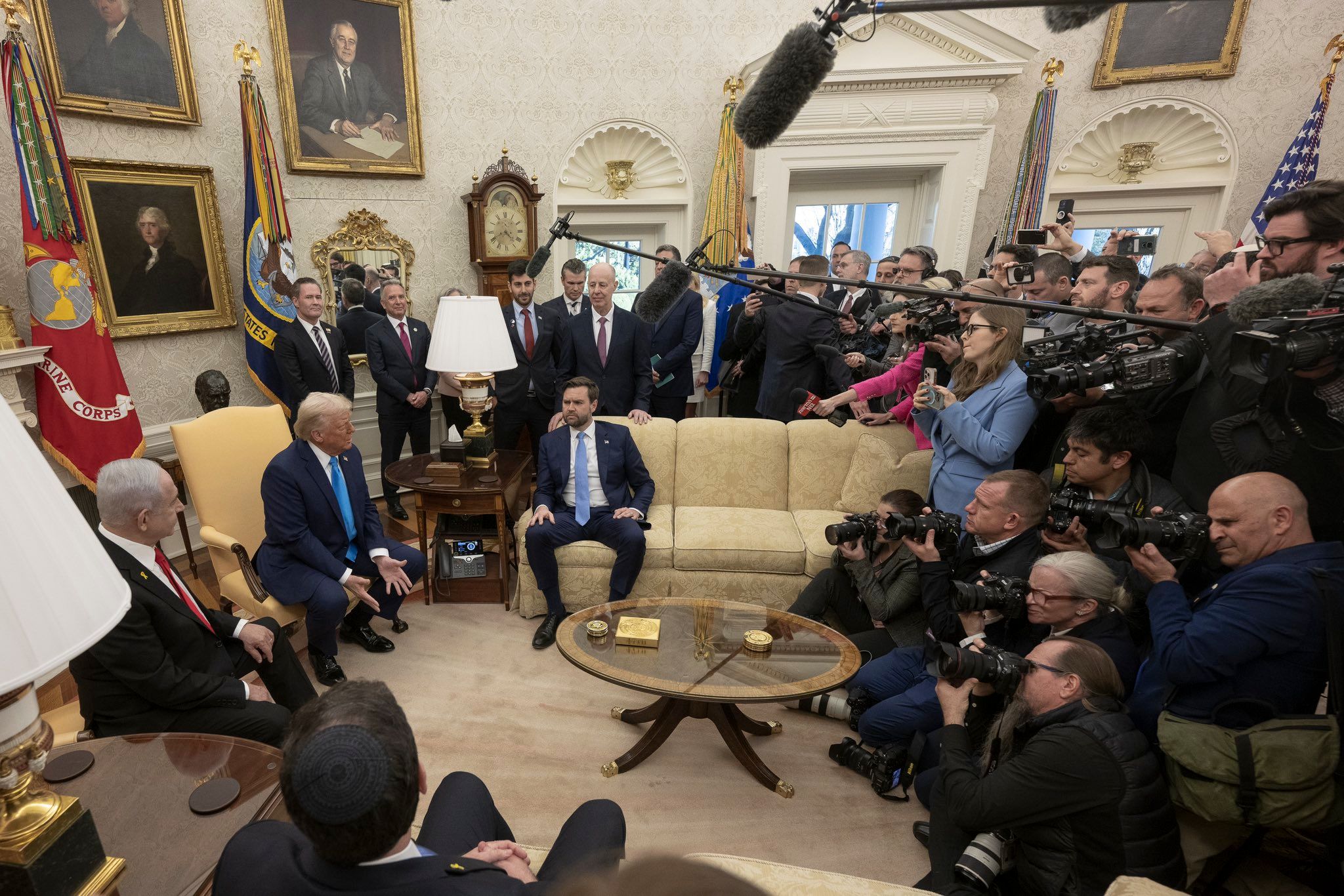
Gold, the sine qua non of dictator chic, is always the keynote.6 No surprise then that Mr. Trump is gilding the White House. He has covered the walls of the Oval Office with gold doodads, turning it into what one critic described as “a gilded rococo hellscape.”7 He has demolished the East Wing and is attempting to replace it with a golden ballroom, a structure that, as preservationists and architectural historians maintain, will overwhelm the White House itself.8 Another example of Mr. Trump’s obsession with dictator chic is his plan, unveiled in October 2025, to build a white-and-gold triumphal arch across the Potomac River from Washington, DC, that will dwarf the Lincoln Memorial.9
Given the ballyhoo and controversies surrounding the arch and the ballroom, Mr. Trump’s relative silence about the garden seems uncharacteristic. To be sure, soon after his return to the White House in January 2025, he reinstated his earlier executive order for a National Garden of American Heroes that would be inaugurated on July 4, 2026. In addition, on July 3, 2025, the White House issued a “fact sheet” titled “President Trump Previews Plans for the Greatest Celebration of America’s Birthday.”10 Subtitled “Advancing Plans to Throw the Greatest Birthday Party in American History,” the two-page fact sheet announced, among other celebratory events, “President Trump will create a ‘National Garden of American Heroes’ park featuring statues of 250 American heroes.” Funding from the “One Big Beautiful Bill,” as the fact sheet put it, would be used “to create these statues and build this new national landmark.” In reality, the National Endowment for the Humanities (NEH) had already provided funding to the tune of $34 million. In April 2025, the NEH solicited artists to submit applications to create up to three statues in the classical style to be chosen from the 250 heroes listed in the January 2025 executive order. According to the NEH, “All statues must be life-size and made of marble, granite, bronze, copper, or brass.” Awardees would receive $200,000 per statue and would be expected to complete their work within eight months.11
The deadline for applications came and went. So too did the notification date, which was September 25, 2025. No awards were announced, at least none publicly. The NEH did put out an informational video in September 2025, in which the agency stated that the first round of grants had ended, and a second round would be opened later in the fall.12 So far, the NEH has posted no information regarding new application dates or deadlines. However, it amended its original announcement, saying that ground breaking for the park—presumably, a ceremony featuring Mr. Trump—would take place on the Fourth of July 2026. In addition, on May 15, 2026, Mr. Trump announced that the garden will be located in West Potomac Park, which is adjacent to the Washington Mall, not far from the Washington Monument and Lincoln Memorial, close to the Martin Luther King, Franklin Delano Roosevelt, Korean War, and Jefferson memorials, a little more than a mile from the White House.13 Plans for the garden were soon mired in controversies and lawsuits. Nonetheless, in August 2026, the administration began work on the site.14
What will the garden look like? How will it be organized? On the same day Mr. Trump announced where the garden would be located, the National Garden of American Heroes Foundation, a tax-exempt nonprofit, made available a “pledge agreement” on the Democracy Forward website.15 The pledge agreement features eleven AI renditions, mainly aerial views, of the garden. One provides a general sense of the garden’s projected layout. It will border the Tidal Basin to the north and the Potomac River to the south. There will be a pavilion, a large rectangular lawn, and a circular open space with, apparently, a fountain at its center. Pillars will straddle a walkway leading to the Potomac. Two arms will stretch out into the Potomac itself. Another rendering imagines the garden in spring: Cherry trees bloom, strollers and bicyclists enjoy the sunshine, a couple lounges on the grass, a young girl holding balloons ambles along a pathway. Gray-green patinated bronze statues of heroes appear in the middle ground. On the Virginia side of the Potomac, Mr. Trump’s massive triumphal arch completes the idyllic scene.


Heroes in the Age of Spectacle
So far, we have an inkling of what the garden will look like, but it remains unclear how the statues of 250 great Americans will be organized. We also do not know if anyone has received a commission to produce a statue. Moreover, we are left wondering how a sculptor could carve a lifesize granite or marble statue or, assuming foundries were available, cast a bronze, copper, or brass statue for $200,000.
We are also in the dark about how the garden’s 250 American heroes were selected. How, in 2020 or early 2021, did the administration choose 250 politicians, businesspeople, athletes, actors, writers, artists, singers, and pop culture icons? The list of the garden’s heroes, which appeared in the president’s January 2021 executive order, seems to have materialized out of thin air.16 Selections appear arbitrary. Apparently the only set qualification was that the hero was no longer with us. Some choices were predictable—presidents, congressmen, Supreme Court judges, including Antonin Scalia and Ruth Bader Ginsburg. Other “heroes” lack minimal name recognition: Desmond Doss, George L. Fox, Hans Christian Heg. Ironies abound. Several socialists, communists, communist sympathizers, and ex-communists appear on the list, including Woody Guthrie, Dr. Seuss, Dorothy Day, and Albert Einstein. Also on the list is the philosopher Hannah Arendt, remembered for her study of authoritarianism and for coining the phrase “banality of evil.” However, Founding Father, atheist, and radical democrat Tom Paine does not rate as an American hero. (Paine wrote Common Sense, an incendiary pamplet that anticipated the Declaration of Independence and inspired thousands to join the revolution.) A large number of celebrities do make the list, among them four screen actors famous for playing heroes: Humphrey Bogart, Ronald Reagan, Jimmy Stewart, and John Wayne. The presence of these and other celebrities—Louis Armstrong, Lauren Bacall, Ingrid Bergman, Ray Charles, Nat King Cole, Aretha Franklin, Bob Hope, Whitney Houston, Elvis Presley, Frank Sinatra, Shirley Temple, Alex Trebek—attests to the president and his staff’s lack of interest in distinguishing between real and simulated heroism.
Mr. Trump inhabits the world of spectacle. He is both its creature and captive. The spectacle—I am using the term in the sense Marxist-Situationist Guy Debord defined it—reduces history to a timeless media space occupied by boldface names: Gwyneth Paltrow, Pete Hegseth, George Clooney, the Dalai Lama, Bill Clinton, Lady Gaga.17 As an inhabitant of the spectacle, the president is obsessed with his image—his hair, his skin tone, the color and length of his tie—and with the settings in which he is seen, interviewed, filmed, photographed, and recorded (fig. 1). T. J. Clark has observed that Mr. Trump “sits watching [Fox News] for hours each day—rightly understanding that by doing so, he is doing politics, politics as our society now practises it.”18 He is an avatar of the spectacle, its incarnation. Like Big Brother in George Orwell’s 1984, his name and image must be everywhere.
With his advisor, Charles Colbert, Louis XIV—Louis Quatorze—created Versailles as an instrument of political domination, a strategy dramatized in Roberto Rossellini’s unforgettable 1966 film, La prise de pouvoir par Louis Quatorze (Louis XIV’s seizure of power).19 Louis was and remains the Sun King—Le roi de soleil. He is ubiquitous at Versailles in the guise of Apollo, the sun god; bringer of light, enlightenment, and rationality; patron of the Muses, of poetry, music, song, and dance. He dominates the garden. The view from the palace’s Hall of Mirrors has, as its principal focus, the fountain of Apollo, which is located at the western end of a stately, tree-and-statue-lined allée. From there Apollo can be seen driving his chariot as it rises from the water to begin its daily progress from east to west across the sky.
Like Louis Quatorze, Mr. Trump is hyperaware of how his surroundings shape his image. Since the early 1990s, he has lived and worked in settings that simulate palatial grandeur. The three-story penthouse at the top of Trump Tower, with its ostentatious display of luxurious materials, furnishes a setting fit for a prince of real estate and high finance. Like Mar-a-Lago and the Trumpified White House, it is an environment that can inspire fever dreams of absolutism and the divine right of kings. Mr. Trump’s insistence on the trappings of royalty extends to his planned White House ballroom, which will function as a setting for presidential receptions, dinners, speeches, and ceremonies; to his arch, which will celebrate his political and martial triumphs; and to his semiquincentennial garden.
Like the gardens at Versailles, the National Garden of American Heroes will be in the classical or “eternal” style. And like Versailles, it will be dedicated to the glory of the nation’s leader—in this instance, a would-be monarch who would have us believe he is the embodiment and personification of 250 years of American heroism.
Cite this article: Alan Wallach, “Mr. Trump’s Semiquincentennial Garden,” in “The Art History of the 250th Anniversary,” In the Round, edited by K. L. H. Wells, Panorama: Journal of the Association of Historians of American Art 12, no. 2 (Fall 2026), https://doi.org/10.24926/24716839.21361.
Notes
- “Remarks by President Trump at South Dakota’s 2020 Mount Rushmore Fireworks Celebration,” The White House, July 4, 2020, https://trumpwhitehouse.archives.gov/briefings-statements/remarks-president-trump-south-dakotas-2020-mount-rushmore-fireworks-celebration-keystone-south-dakota. ↵
- “Remarks by President Trump at South Dakota’s 2020 Mount Rushmore Fireworks Celebration.” ↵
- Revision to Exec. Order No. 13934, “Executive Order on Building the National Garden of American Heroes,” January 18, 2021, https://trumpwhitehouse.archives.gov/presidential-actions/executive-order-building-national-garden-american-heroes. ↵
- Peter York, “Trump’s Dictator Chic,” Politico Magazine (March/April 2017), https://www.politico.com/magazine/story/2017/03/trump-style-dictator-autocrats-design-214877. ↵
- Robert Wellington argues that even though Mr. Trump claimed that the ballroom at Mar-a-Lago took its inspiration from Versailles, his taste for the art of the ancient régime derives not directly from Versailles but belongs “to an American tradition for the newly rich to signal their social ascension.” Wellington’s argument does not contradict the idea that Trump’s taste can be described as “dictator chic.” Robert Wellington, Versailles Mirrored: The Power of Luxury; Louis XIV to Donald Trump (Bloomsbury Visual Arts, 2025), 141. ↵
- For the design of Mr. Trump’s penthouse apartment, see Wikipedia, “Trump Tower Penthouse of Donald Trump,” last modified August 27, 2026, https://en.wikipedia.org/wiki/Trump_Tower_penthouse_of_Donald_Trump. For the ballroom at Mar-a-Lago, see Kristina Webb, “Trump’s White House Ballroom: A Look Back at Grand Ballroom President Built at Mar-a-Lago,” Palm Beach Daily News, August 5, 2025, https://www.palmbeachpost.com/story/news/trump/2025/08/05/trump-white-house-ballroom-a-look-back-at-mar-a-lagos-grand-ballroom/85522726007; and Kristina Webb, “Look Inside the Donald J. Trump Grand Ballroom at Mar-a-Lago,” Palm Beach Daily News, August 2, 2025, https://www.palmbeachdailynews.com/picture-gallery/news/trump/2025/08/02/look-inside-the-donald-j-trump-grand-ballroom-at-mar-a-lago/85469139007. ↵
- Emily Keegin, “Trump’s Oval Office Is a Gilded Rococo Nightmare. Help,” New York Times, May 27, 2025, https://www.nytimes.com/2025/05/27/opinion/trump-oval-office-rococo.html. ↵
- See Emily Badger, Junho Lee, and Larry Buchana, “Trump’s Ballroom Design Has Barely Been Scrutinized,” New York Times, March 29, 2026, https://www.nytimes.com/interactive/2026/03/29/upshot/white-house-ballroom.html. ↵
- See Sam Sifton, “A Huge Arch,” New York Times, April 17, 2026, updated June 4, 2026, https://www.nytimes.com/2026/04/17/briefing/a-huge-arch.html. ↵
- “Fact Sheet: President Donald J. Trump Previews Plans for the Grandest Celebration of America’s Birthday,” The White House, July 3, 2025, https://www.whitehouse.gov/fact-sheets/2025/07/fact-sheet-president-donald-j-trump-previews-plans-for-the-grandest-celebration-of-americas-birthday. ↵
- “NEH Announces Grant Opportunities to Create Statues of Iconic Americans for the National Garden of American Heroes,” National Endowment for the Humanities, April 24, 2025, https://www.neh.gov/news/neh-announces-grant-opportunity-create-statues-iconic-americans-national-garden-american. ↵
- NEH and America 250: Funding Opportunities at the National Endowment for the Humanities,” posted August 19, 2025, by National Endowment for the Humanities, YouTube, 22 min, 43 sec., https://www.youtube.com/watch?v=qXohEQnIhvc. ↵
- Dan Diamond, “Trump Announces Planned D.C. Site for Massive Sculpture Garden,” Washington Post, May 15, 2026, https://www.washingtonpost.com/politics/2026/05/15/trump-announces-west-potomac-park-is-planned-site-dc-garden-heroes. ↵
- See Dan Diamond, “D.C. Groups Sue Over Trump’s Planned ‘Garden of American Heroes,’” Washington Post, June 15, 2026, https://www.washingtonpost.com/politics/2026/06/15/trump-garden-heroes-draws-lawsuit-over-west-potomac-park-changes; and Emily Badger, “Trump’s D.C. Makeover Projects Are ‘Only an Idea,’ Until They Are Much More,” New York Times, September 3, 2026, https://www.nytimes.com/2026/09/03/upshot/trump-dc-mall-garden-heroes.html. ↵
- It is curious that the Foundation’s pdf is available on an anti-MAGA website and apparently nowhere else: The National Garden of American Heroes Foundation, “Pledge Agreement,” accessed August 14, 2026, https://democracyforward.org/wp-content/uploads/2026/05/FINAL-THE-NATIONAL-GARDEN-OF-AMERICAN-HEROES-FOUNDATION.pdf ↵
- For the complete list, see Wikipedia, “National Garden of American Heroes,” last updated July 11, 2026, https://en.wikipedia.org/wiki/National_Garden_of_American_Heroes. ↵
- See Guy Debord, The Society of the Spectacle, trans. Donald Nicholson-Smith (Zone, 1967, repr. 1998). ↵
- T. J. Clark, “A Brief Guide to Trump and the Spectacle,” London Review of Books, January 2025, 47n1, https://www.lrb.co.uk/the-paper/v47/n01/t.j.-clark/a-brief-guide-to-trump-and-the-spectacle. ↵
- See Wikipedia, “The Taking of Power by Louis XIV,” last updated June 11, 2026, https://en.wikipedia.org/wiki/The_Taking_of_Power_by_Louis_XIV. ↵
About the Author(s): Alan Wallach is professor emeritus of art history and American studies at the College of William and Mary, Williamsburg, VA, and professorial lecturer in art history at George Washington University, in Washington, DC.