

In the Galleries





PDF: McGoey and Picard, introduction to In the Galleries
Introduction
Contributors
Michaela R. Haffner, Amon Carter Museum of Art, Fort Worth, TX
Sofia Ortega-Guerrero, Art Institute of Chicago
Virginia M. G. Anderson, Baltimore Museum of Art
Caroline Culp, Chrysler Museum of Art, Norfolk, VA
Austen Barron Bailly, Crystal Bridges Museum of American Art, Bentonville, AK
Emma Acker, de Young Museum, San Francisco
Katherine Jentleson and Anni A. Pullagura, High Museum of Art, Atlanta
Nandini Makrandi and Lauren Nye, Hunter Museum, Chattanooga, TN
Adrienne Spinozzi and Sylvia Yount, The Metropolitan Museum of Art, New York
Thomas Busciglio-Ritter, Milwaukee Art Museum
Elizabeth Driscoll Smith, Museum of Fine Arts, Boston
Kaylin H. Weber and Christine Gervais, Museum of Fine Arts, Houston
Petra Slinkard, Peabody Essex Museum, Salem, MA
Kathleen A. Foster and Julia Hamer-Light, Philadelphia Museum of Art
Melissa Wolfe and Amy Torbert, Saint Louis Art Museum
Theresa Papanikolas, Seattle Art Museum
Siera Hyte and Leo Mazow, Virginia Museum of Fine Arts, Richmond
Erin Monroe and Katherine Tycz, The Wadsworth, Hartford, CT
Karen Sherry, Worcester Art Museum, MA
Soon after the US sesquicentennial was celebrated in 1926, Metropolitan Museum of Art curator William Mills Ivins mused about the function of art museums. In a notebook now in the Archives of American Art, he wrote, “Each period picks out of the past the things that appeal to it and ignores the rest.” He then clarified with his characteristic sardonic edge that “the ‘selective’ collection [is] merely a reflection of the taste of its own time” (fig. 1).1 Thus, almost a century ago, Ivins argued that curatorial decisions were informed by cultural impulses, establishing the museum as a mirror of societal values.
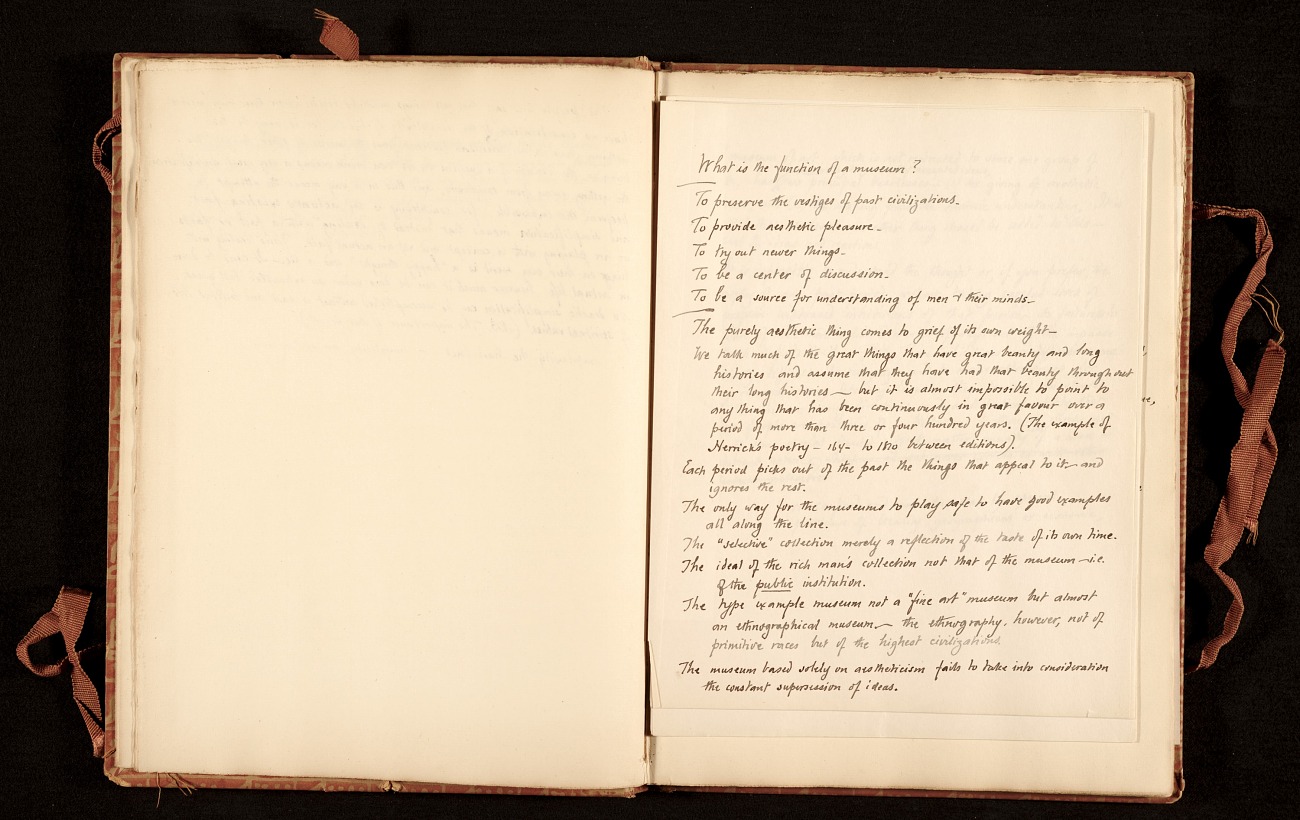
This special issue of “In the Round,” reconceptualized as “In the Galleries,” branches out from Ivins’s private considerations of curatorial practice by offering a platform for museum teams to articulate the goals, stakes, and circumstances of creating displays of American art in public museums today. Our aim is to capture the work being done in displays of collections of American art that explore and expand narratives of artistic innovation, national identity, and more. By no means a comprehensive survey, “In the Galleries” invites readers into nineteen museums with ongoing exhibitions of American art drawn from their permanent collections.2 The selections presented in this issue welcome a range of geographies, architectural footprints, and collection scope from museums coast to coast.
Curatorial practices and strategies are rarely articulated to the public. When such strategies are communicated, permanent collection displays are seldom the main subject. Special exhibitions get the most attention. Installation shots, catalogues, reviews, marketing, digital media, and tributes in historiographies create lasting documents of a vernissage open for six to twelve months. This is certainly the case within the digital pages of Panorama, which has always featured exhibition reviews. Yet installations of permanent collections of American art rarely receive critical attention beyond the institution: outside scholarly evaluation, media attention, or publications are rare, and if they do occur, it often happens after high-profile reinstallations.3
There is recent evidence, however, of more attention being paid to this central part of curatorial practice and museum display. A recent contribution is Michael Hartman and Jami Powell’s edited volume, Reenvisioning Histories of American Art: Transforming Museum Practice. In addition, the New York Times just initiated a special section about art museums that explores how “artists and institutions are adapting to changing times.”4 As these accounts reveal, permanent collection work, which can often be better understood as semipermanent, or rotating, displays from institutional holdings, has the potential to shape, reflect, and refract the zeitgeist.
To be sure, there are archival traces of museum operations and applications for reinstallation funding that shed light on macro views of strategy. For example, flashes of the curatorial philosophy in recent National Endowment for the Humanities (NEH) public grants show that the Museum of Fine Arts, Boston, wanted “to tell the story of the birth of the United States” (2005), the Baltimore Museum of Art planned to “tell the story of American art within an international context” (2012), the Philadelphia Museum of Art proposed to display both local and national art with attention to social justice in the wake of George Floyd’s murder (2018), and the Brooklyn Museum of Art intended to, in their words, “elevate and amplify the voices of those traditionally underrepresented in major museum installations” (2021).5 Often formulated in an aspirational phase, rarely do these documents provide frame- or pedestal-level choices.
We hope that these virtual postcards from “In the Galleries” lead to conversations about curatorial decision-making in ongoing installations of American art. What epistemological knowledge guides these practices? How can uncovering the intellectual and political process of curatorial work in permanent collections benefit engagement and discourse about their display? What do the patterns across multiple ongoing exhibitions of permanent collections tell us about what “appeals” (as Ivins wrote) and what that attraction reflects about individual and/or shared values? How do objects contribute to history, and how is history used to interpret objects in ways that respond to a historically exclusive canon?
The dynamic curatorial perspectives offered here do not attempt to answer these questions, but they provide a constellation of display and interpretive practices from our present moment. These records, which we hope to see more of in Panorama as a public humanities forum, allow current and future curators, scholars, and art lovers to engage in real-time and retrospective discourse about the process of knowledge production in public collections of American art. The study of diverse artistic production within and beyond the constructed geographies of what is now the United States continues to lay bare the construction of national identity.
As such, there is thought-provoking variety in each peek from the nineteen contributors. The collections discussed, as a whole, span millennia. Geographically, some are hemispheric and others local. There are paintings, sculptures, ceramics, prints, maps, decorative arts, domestic and sacred objects, textiles, and multimedia images. Many of the display strategies articulated in the reflections juxtapose works across long-held boundaries, integrate a range of media, and rely on thematic organization as opposed to strictly chronological and geographic approaches. New models of curatorial decision-making and community collaboration have shaped these installations. Universally, these reflections emphasize goals of complicating and expanding the definition and presentation of American art by addressing long-standing patterns of gender, cultural, ethnic, and religious disparities.6
Certainly, what emerges from this survey is awareness that inclusion and expansion are at the fore of current curatorial work, evident in the range of artists and artworks represented as well as the voices that help shape interpretation and gallery narratives. In this year of the semiquincentennial, as the United States of America reflects on its foundation and history—and reckons with administrations (governmental as well as academic) that are hostile to diversity, inclusion, equity, and the arts—the work being done to display permanent collections of American art emphasizes that there is no single definition or story of American art, just as there no one way to understand what it means to be American. Indeed, being American is not always the defining idea of the objects in American galleries.
We hope that this medley from curators actively shaping contemporary spaces and interpreting diverse collections serves both as notes from the field and as a lure to experience these efforts—and importantly, these artworks—in person.
Cite this article: Elizabeth McGoey and Sara Picard, “Introduction,” in “In the Galleries,” edited by Elizabeth McGoey and Sara Picard, Panorama: Journal of the Association of Historians of American Art 12, no. 1 (Spring 2026), https://doi.org/10.24926/24716839.20868.
Notes
- William Mills Ivins (1881–1961) was a lawyer and print collector before he became the Metropolitan Museum of Art’s first curator of prints in 1916. Throughout his tenure, he held that position concurrently with being assistant director and acting director. ↵
- This was a difficult survey to narrow down, and we acknowledge that there are myriad institutions doing exciting work that are not featured in this exploratory section. The parameters we chose included public art museums with ongoing permanent displays of American art that were not university and college museums supported by a larger academic community. ↵
- Two such publications are the catalogue that accompanied the opening of the American Wing at the Museum of Fine Arts, Boston, in 2010: Elliot Davis, A New World Imagined: Art of the Americas (Museum of Fine Arts, Boston, 2010); and the catalogue for the 2025 exhibition at the Brooklyn Museum: Stephanie Sparling Williams, Toward Joy: New Frameworks for American Art (Scala, 2025). ↵
- Michael W. Hartman and Jami C. Powell, Reenvisioning Histories of American Art: Transforming Museum Practice (Hood Museum of Art, Dartmouth, in association with the University of Washington Press, Seattle, 2025). See also “Museums: A Special Section,” New York Times, accessed May 26, 2026, https://www.nytimes.com/spotlight/museums-special-section?smid=url-share; Sylvia Yount, “Braving (and Bridging) the Divide: The Academy and the Museum,” American Art 15, no. 3 (Autumn 2001): 2–7; Andrew Walker, “Coming of Age: American Art Installations in the Twenty-First Century,” American Art 24, no. 2 (2010): 2–8; and Theodore E. Stebbins and Susan Ricci Stebbins, Rethinking American Art: Collectors, Critics, and the Changing Canon (Godine, 2025). ↵
- National Endowment for the Humanities, accessed May 26, 2026: Museum of Fine Arts, Boston: https://awardsearch.neh.gov/AwardDetail.aspx?gn=CZ-50143-08; Baltimore Museum of Art, https://awardsearch.neh.gov/AwardDetail.aspx?gn=GI-50495-12; Philadelphia Museum of Art, https://awardsearch.neh.gov/AwardDetail.aspx?gn=GI-261155-18; Brooklyn Museum of Art: https://awardsearch.neh.gov/AwardDetail.aspx?gn=GE-280383-21. ↵
- Chad M. Topaz, Bernhard Klingenberg, Daniel Turek, Brianna Heggeseth, Pamela E. Harris, Julie C. Blackwood, C. Ondine Chavoya, Steven Nelson, and Kevin M. Murphy, “Diversity of Artists in Major US Museums,” PLoS ONE 14, no. 3 (2019): e0212852, https://doi.org/10.1371/journal.pone.0212852. ↵
About the Author(s): Elizabeth McGoey is the Ann S. and Samuel M. Mencoff Curator, Arts of the Americas, at the Art Institute of Chicago. Sara Picard is professor of art history at Rhode Island College in Providence.